
Sonsoles Massiá · Brutal Beauty
Some works captivate from the very first moment, and that is precisely why one should distrust them for a second. Beauty can be an easy trap. It can remain on the surface, in ornament, in the pleasant condition of an object made to be admired.
But sometimes beauty is not decoration.
Sometimes it is the first door into something stranger, deeper, more alive.
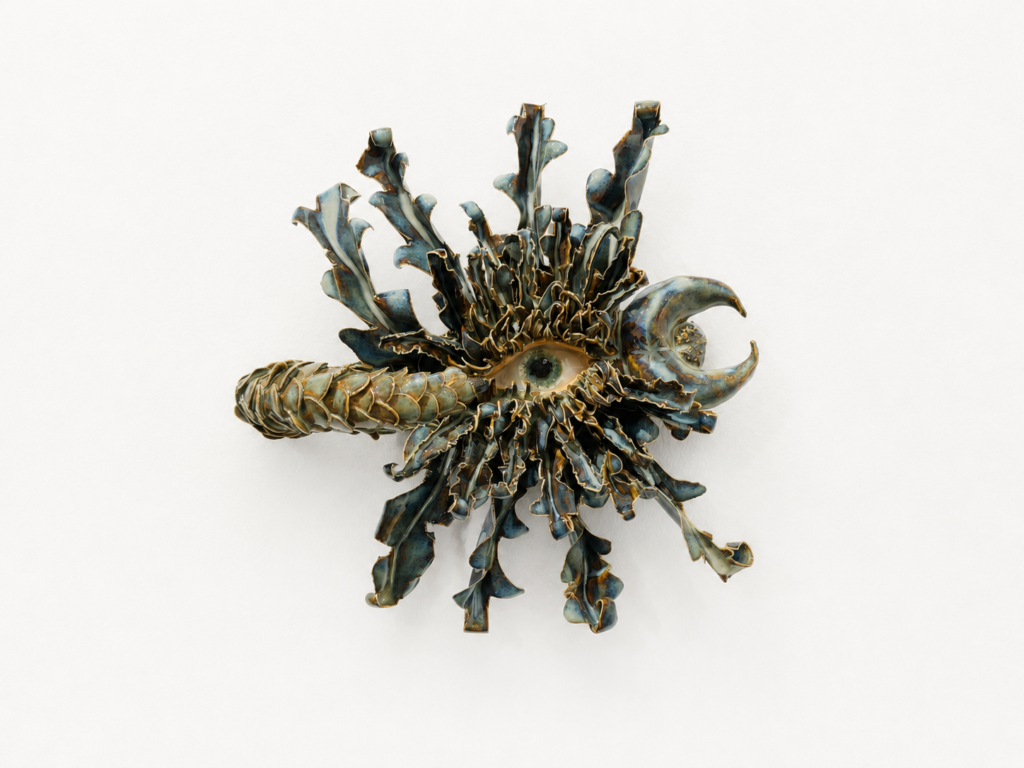
At MARTE Castellón, we came across ceramic pieces that seemed, at first, to be flowers. They worked as flowers. They could inhabit a wall with the immediate force of the organic, the radial, the open. But the longer one stayed with them, the less they remained flowers.
They began to become creatures.
Every detail is treated with almost obsessive delicacy. There is no desire to show quickly, no rush to produce an immediate effect and then disappear. There is instead a will to recreate deeply: every leaf, every edge, every fold, every shadow, every nuance of glaze.
The artist does not copy nature. She allows clay to imagine its own version of life.
Because we are no longer looking at a represented flower, but at a form that seems to have found its own breathing. Clay does not imitate an external life; it begins to behave as if life had been born inside it. The leaves twist, open, defend themselves, expand. The piece seems to grow according to an inner law, as if each fragment obeyed an organic impulse that does not seek merely to please, but to exist.
There is delicacy here. A great deal of it. It is a delicacy capable of stinging.
The artist creates flowers as she creates scorpions, or as if she understood that between a flower and a scorpion there is less distance than we usually believe. Both seduce. Both have form. Both contain a silent intelligence. Both can enchant you with their delicate presence and, at the same time, remind you that what is alive is never entirely harmless.
In some pieces, an eye appears.
And then the work definitively stops being an object.
It looks back.
The flower becomes creature, mask, vigilant centre, symbolic organism. Ornament turns into presence.
The glaze also seems to move organically. It does not cover the form like a dead skin; it travels with it. The milky whites, the greys, the blues, the golden edges, the gloss, the shadows projected onto the wall — everything collaborates so that the piece does not end in its own matter.
The ceramic continues into its shadow.
The wall becomes a second surface of apparition.
There is something almost miraculous in this kind of care. When attention is extreme enough, matter begins to breathe. What could have remained beautiful becomes alert. What could have been decorative becomes alive. What could have simply pleased us begins to look at us from somewhere older than language. Brutal Beauty